

THE PROCESS
From Vision to Sculpture
Turning the idea of a sculpture into a finished artwork is a long and meticulous process involving many different stages, skills and countless hours of refinement.
I chose to work primarily with moulded resin because I believe it gives my sculptures the presence, surface quality and depth I am looking for. It is a material that allows extremely precise finishes while offering exceptional durability over time.
Every sculpture begins with an idea — and, very often, with a conversation.

01
Understanding the car
The process starts with an exchange with the client. I study photographs of the car, its configuration, colour, details and, most importantly, what makes that particular car special to its owner.
The objective is not simply to reproduce a vehicle, but to understand its character and translate it into a sculptural object.
02
Designing the sculpture
I usually develop three or four different interpretations before selecting the one that gives the artwork the strongest sense of movement, tension and balance.
At this stage, proportions can be deliberately transformed. Certain lines are exaggerated, others simplified or stretched, in order to create a sculpture that evokes the car rather than simply replicating it.


03
Creating the master model
Once the design is finalised, the digital model is prepared for 3D printing. Large sculptures often need to be divided into several interlocking parts, and the construction is discussed with the moulding team in order to anticipate the next stages of production.
The different elements are then 3D printed. At this scale, printing inevitably involves imperfections and tolerances that need to be corrected by hand.
04
Refining by hand
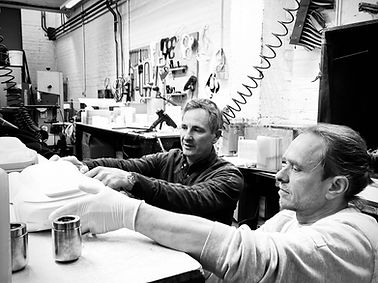
The printed parts are assembled to create the original master.
Then begins one of the most time-consuming parts of the process: sanding, correcting, reshaping and sanding again.
This can continue for several days until every curve, junction and surface reaches the quality required for moulding.

05
Moulding & casting
A silicone mould is created from the finished master.
The moulding team then casts a small number of resin pieces from it. Each casting is inspected and prepared individually before moving to the finishing stages.
06
Colours & details
The correct automotive paints are ordered for the project. For particularly rare or historic colours, I sometimes create and adjust the mixture myself in order to reproduce the original shade as faithfully as possible.
If the design includes several colours, racing liveries or graphic elements, I prepare the necessary masks and stencils.
Additional elements such as wings or aerodynamic components are also produced separately, in metal or resin depending on the design.


07
Painting
The sculpture is then painted in a professional spray booth by the painting team, following my specifications and colour references.
Several layers of paint and clear coat are applied to achieve the required depth and finish. On selected pieces, a ceramic coating can also be applied as a final protective treatment.
This is always a decisive moment in the project: after weeks of design, preparation and craftsmanship, the sculpture finally reveals itself.
08
The bespoke base
In parallel, a custom base is manufactured according to my drawings and adapted specifically to the proportions and character of the sculpture.
The finished artwork is then carefully assembled and mounted onto its base.


09
Signature & certification
Each sculpture is individually signed and accompanied by its Certificate of Authenticity, also signed by hand.
These final details mark the transition from an object in production to a completed artwork.
10
Packaging & delivery
The sculpture is protected in a bespoke presentation box with custom-cut foam supports designed specifically for its shape.
Depending on the destination and the project, the artwork is then delivered personally, shipped directly to the collector, or delivered to one of the galleries or showrooms presenting my work.

What appears at first sight to be a simple form is therefore the result of weeks of design, experimentation, technology and craftsmanship.
From the first sketch to the final coat of lacquer, every decision has one purpose: to transform the identity of an exceptional car into a lasting piece of sculpture.
